Muse AI and the Future of Digital Careers: Features, Uses, and Skills to Learn in 2026
- Home
- Blog
- Consulting
- Muse AI and the Future of Digital Careers: Features, Uses, and Skills to Learn in 2026
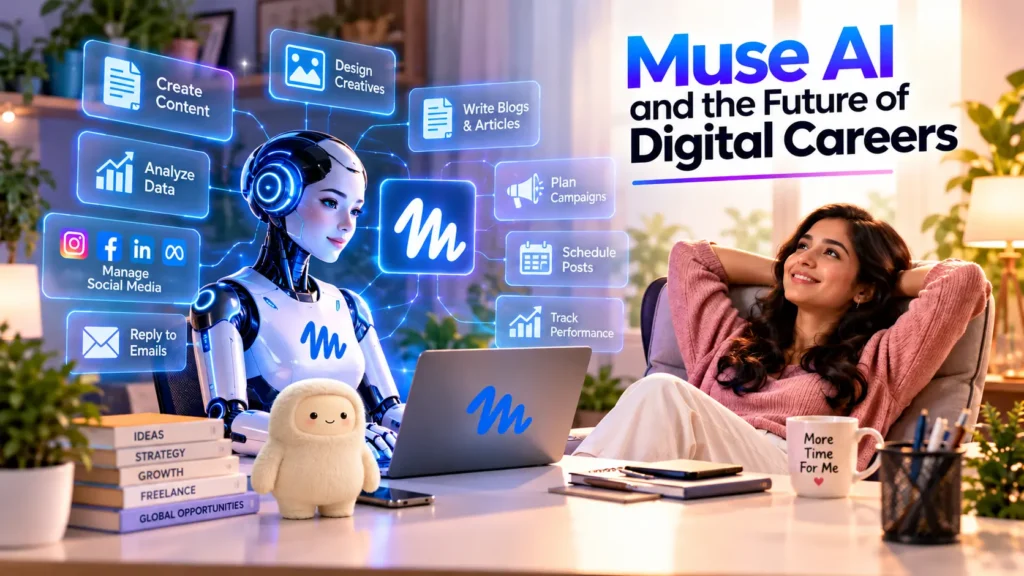
Technology is opening up new ways to solve problems, develop creative ideas, and complete professional tasks. One emerging area attracting interest is artificial intelligence, particularly tools that can understand instructions, generate visual content, and assist with digital activities. Meta’s Muse AI developments offer an interesting example of how these capabilities are evolving.
For students and professionals, understanding new AI technologies is not just about following technology news. It is also about discovering how these tools may be applied in marketing, design, software development, education, and business operations.
However, technology alone does not guarantee career success. People need practical knowledge, creativity, and the ability to evaluate AI-generated results. Learners interested in building these abilities can explore suitable courses and identify an artificial intelligence training institute that aligns with their professional interests.
This article explores the different aspects of Muse AI, its potential applications, important considerations when using AI tools, and how students in Kochi can prepare for a technology-driven workplace.
Understanding the Different Technologies Behind Muse AI
Muse AI is associated with Meta’s developments in artificial intelligence. The name appears in connection with different technologies and experiences, so it is important to understand their individual purposes instead of treating them as a single tool.
Muse Spark: Understanding Language and Instructions
Muse Spark is a language model developed by Meta Superintelligence Labs. Language models are designed to process information, interpret instructions, and generate responses based on the input they receive.
These capabilities can support activities such as writing, research, coding assistance, and information analysis. For example, a professional might use a language model to organize ideas before preparing a report or to explore different approaches to a problem.
The quality of the result depends on the model’s capabilities, the instructions provided, and the information available. Generated answers should always be checked before being used for important decisions.
Muse Image: Exploring AI-Assisted Visual Creation
Image-generation technology allows users to describe a visual idea using text and explore possible designs with AI assistance.
A digital marketing team could use these tools to develop initial campaign concepts, while a designer might experiment with different visual styles before creating the final artwork.
AI-generated images can make idea development faster, but they do not eliminate the need for professional design knowledge. Typography, layout, brand consistency, image quality, and visual communication still require careful attention.
Muse Video: New Possibilities for Video Production
AI-assisted video technologies aim to support creative production and digital storytelling. Depending on the available product and features, AI tools may help with parts of a video workflow.
Content creators can also use other AI applications to brainstorm video topics, prepare scripts, generate captions, and organize storyboards.
The final video still needs human direction to ensure that its message, timing, audio, and visual elements work together effectively.
Muse as an Intelligent Personal Assistant
AI agents represent another area of development. Unlike conventional chatbots that primarily respond to questions, an AI agent may be designed to assist with a sequence of tasks using supported tools and integrations.
Depending on its permissions and available features, an agent may help gather information, prepare drafts, organize activities, or interact with connected applications.
Availability varies by product, country, device, and account eligibility. Users should check official Meta announcements before assuming that a particular Muse feature is available to them.
What Makes Modern AI Assistants Different From Traditional Chatbots?
Traditional chatbots are commonly used to answer questions, provide information, and generate text. More advanced AI assistants aim to support broader workflows by combining language understanding with tools and integrations.
Consider a student preparing a presentation on digital marketing. A basic chatbot might explain the topic or suggest an outline. A more capable AI-assisted workflow could help organize research, prepare draft content, suggest presentation ideas, and arrange information into sections, depending on the tools available.
There are several important stages in this process.
Understanding the instruction: The system interprets the user’s request and identifies the intended outcome.
Processing the information: The AI uses its model capabilities and available context to develop a response or plan.
Using supported tools: When integrations and permissions allow, the system may interact with external applications or services.
Producing the result: The output could be written content, a summary, a set of suggestions, or a creative asset.
Human verification: The user checks the result for accuracy, relevance, quality, and suitability.
AI systems can still misunderstand instructions, produce incorrect information, or overlook important details. Users should also review privacy settings before connecting AI tools to personal or business accounts.
Practical Ways to Apply AI in Different Careers
AI is becoming relevant to many professional activities. Its usefulness depends on the task, the tools selected, and the user’s ability to apply the results appropriately.
AI in Digital Marketing
Digital marketers can use AI applications to explore campaign ideas, prepare content outlines, draft captions, and organize content calendars.
For instance, when promoting a training course, a marketer could generate several headline variations and then adapt the strongest ideas to the target audience.
AI may also assist with brainstorming blog topics and organizing keyword research. However, keyword selection, search intent, brand messaging, campaign targeting, and performance analysis require human judgement and verification.
Marketers who combine AI-assisted workflows with SEO, social media management, advertising, and analytics knowledge can develop a broader professional skill set.
AI in Graphic Design and Creative Work
Creative professionals can use AI tools to explore visual concepts, create references, and experiment with different design directions.
A designer working on a promotional poster might generate several background concepts before selecting one for further development. This can support the creative process without replacing the designer’s role.
Professional design also involves typography, spacing, colour combinations, composition, and brand guidelines. AI-generated text and images may contain errors, so every asset needs a quality check before publication.
AI in Software Development
Programming assistants can help developers understand unfamiliar code, explore solutions, identify possible bugs, and prepare initial code examples.
For beginners, these tools may provide additional explanations while learning programming concepts. Experienced developers may use them to investigate technical problems or speed up selected routine tasks.
Nevertheless, AI-generated code can contain errors or security weaknesses. Developers must test their work and understand the code they use rather than relying on generated answers without verification.
AI in Accounting and Office Administration
AI applications can help professionals organize information, draft business communications, summarize documents, and support selected reporting activities.
When combined with accounting software and spreadsheet applications, AI may assist with repetitive administrative work and information management.
However, financial calculations, compliance-related work, and business records require accuracy. Confidential information should also be handled according to appropriate organizational policies and data-protection requirements.
AI in Data Analysis
Data professionals can explore AI tools to summarize datasets, explain analytical concepts, and develop initial ideas for reports.
For example, a learner working with spreadsheet data could use an AI assistant to understand a formula or explore ways to organize information.
The analyst must still validate calculations, check the quality of the dataset, and interpret the findings correctly. AI-generated explanations should not replace sound analytical methods.
AI in Education and Learning
Students can use AI tools to explore difficult concepts, organize revision notes, prepare practice questions, and create initial research outlines.
These applications can support learning when students actively review the material and verify the information provided.
The best approach is to use AI as a learning aid rather than a substitute for independent thinking. Developing subject knowledge, communication skills, and problem-solving abilities remains important.
Skills to Develop Alongside Artificial Intelligence
Learning to use AI applications is useful, but professional growth requires a combination of technical knowledge and practical experience.
Students can consider developing the following skills according to their chosen career path.
- Digital marketing: SEO, social media strategy, content planning, advertising, and performance analytics.
- Graphic design: Visual composition, typography, image editing, and brand identity.
- Programming: Coding fundamentals, logical thinking, debugging, and software development.
- Accounting: Financial concepts, accounting software, spreadsheet skills, and accurate reporting.
- Data analysis: Data cleaning, spreadsheet formulas, visualization, and interpretation.
- Communication: Writing, presenting ideas, collaborating with teams, and explaining technical information.
AI tools can support some of these activities, but a strong foundation helps learners identify when AI is useful and when a task requires a different approach.
For students who want structured guidance, choosing an artificial intelligence training institute is one option to consider alongside relevant professional courses. Before enrolling, identify the skills you want to develop and confirm whether the available training matches those objectives.
How to Select a Course That Matches Your Career Goals
Not every learner needs the same training. A student interested in creative work may benefit from design and digital content courses, while someone interested in technology may prefer programming or data-related subjects.
Use these factors when comparing different training programs.
1. Define Your Learning Objective
Decide whether you want to improve your existing professional skills, learn a new subject, or prepare for an entry-level role. A clear objective makes it easier to compare courses.
2. Review the Course Syllabus
Look for a syllabus that explains the subjects covered, the tools used, and the expected learning outcomes. If AI is a major reason for enrolling, ask whether the course includes dedicated AI training or only introduces selected AI tools.
3. Look for Practical Assignments
Practical exercises help you apply what you learn. Projects can also provide examples of your work for a portfolio or future job applications.
4. Check the Trainer’s Experience
Understand the trainer’s subject knowledge, professional background, and approach to teaching. Clear explanations and opportunities to ask questions can improve the learning experience.
5. Understand the Course Details
Before making a decision, confirm the course duration, fees, learning format, assessment method, and any certification provided.
6. Consider Career Relevance
Select training that supports your intended career direction. A course should help you develop applicable knowledge rather than simply introduce a collection of popular tools.
Comparing these factors can help you identify an artificial intelligence training institute or professional training program that suits your background and future plans.

Explore Learning Opportunities at G-TEC Education Palarivattom
Students and working professionals looking for career-oriented education in Kochi can contact G-TEC Education Palarivattom to enquire about suitable training options.
Depending on current availability, learners may explore programs related to accounting, software development, digital marketing, and creative technologies. These fields offer different pathways for people with varied interests and professional goals.
Accounting and Finance
Learners interested in financial and business operations can enquire about relevant programs involving subjects and tools such as:
- Tally
- SAP and SAP S/4HANA
- Zoho
- Advanced Excel
- Other accounting and finance training options
Such skills can support learning in accounting, financial reporting, and business administration.
Programming and Software Development
Students interested in technology can enquire about courses related to:
- Python programming
- Full Stack Development
- Other available software development programs
These subjects can help learners build technical foundations and understand how software and digital applications are developed.
Digital Marketing and Creative Technologies
For learners interested in marketing, visual communication, and content production, possible areas to enquire about include:
- Digital Marketing
- Graphic Designing
- Game Designing
- Video Editing
- Building Designing
- Other available creative and technical programs
Students can compare these options according to their interests, existing experience, and career plans.
If you are researching an artificial intelligence training institute in the Palarivattom or Kochi area, contact G-TEC Education Palarivattom to ask about current course availability, syllabus, fees, duration, certifications, and practical training opportunities.
Confirm whether your preferred course includes AI-specific modules before enrolling. This will help you understand what you can expect to learn and whether the program matches your objectives.
Preparing for a Workplace Where AI Is Becoming More Common
The development of Muse AI reflects broader changes in how artificial intelligence is being explored for communication, creative work, and digital assistance.
For learners, the important question is not simply which AI tool is popular today. It is how to build knowledge that remains useful as applications and workplace expectations change.
Start by developing a foundation in a field that interests you. Explore relevant AI tools, practise using them for appropriate tasks, and evaluate the quality of their results. Build projects that demonstrate your abilities, and continue updating your knowledge as new technologies become available.
G-TEC Education Palarivattom can be contacted for information about its current professional training options. Comparing courses carefully and choosing one that aligns with your goals can help you plan your next learning step.
Artificial intelligence may change how many tasks are completed, but practical knowledge, creativity, critical thinking, and responsible decision-making remain valuable professional abilities.